← Back to Famous Multipotentialites
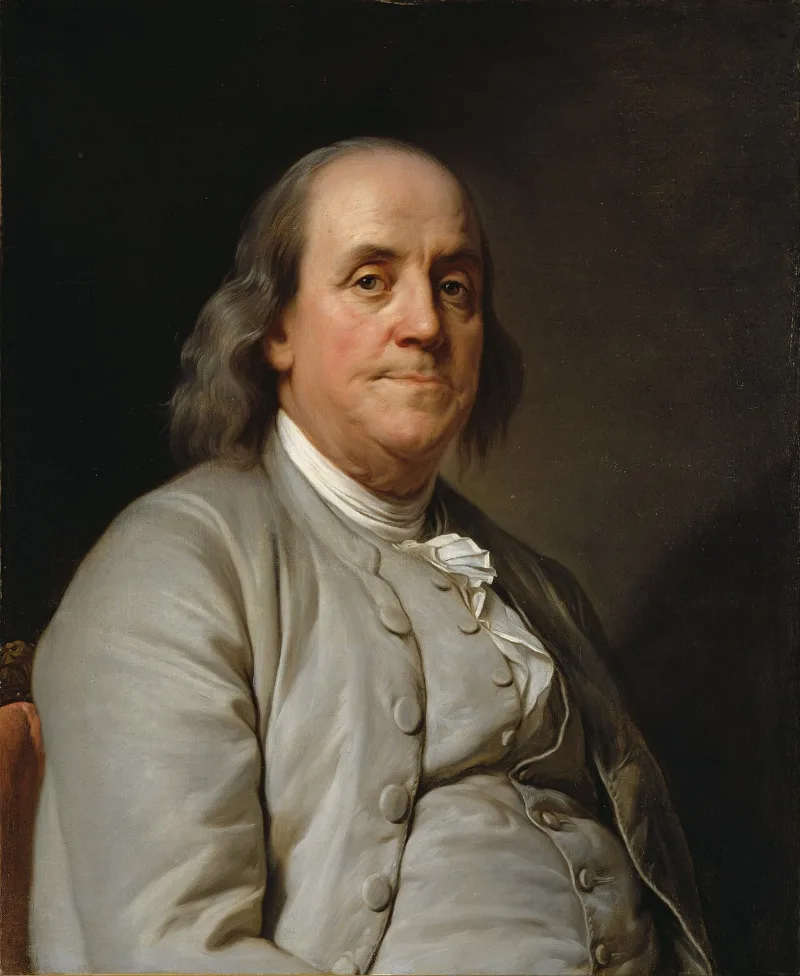
If I had to sum up Benjamin Franklin’s life with a single title, I would certainly fail; his greatness doesn’t fit into one word. He was, all at once, a printer, writer, journalist, scientist, inventor, entrepreneur, politician and diplomat.
Benjamin Franklin at a Glance
- Born – died: January 17, 1706, Boston – April 17, 1790, Philadelphia
- Roles: printer, writer, journalist, scientist, inventor, entrepreneur, politician and diplomat
- Famous inventions: the lightning rod, bifocal glasses, the Franklin stove
- Political role: a signer of the Declaration of Independence and American envoy to France
- Why a multipotentialite? He wove skills from different fields together and turned them into a “combined expertise.”
But for me, Sarah Zarei, the most fascinating part of Franklin’s life isn’t the long list of roles. The more interesting question is this: what makes a person, instead of choosing one path and staying in its safe zone, keep getting pulled toward new territory? Is it scatter — or an evolved form of talent?
When I look at Franklin’s life through the lens of multipotentiality, I meet a man whose problem was never finding “a job”; his problem was what to do with the boundless capacity of his mind and curiosity. Stay with me to see what this eighteenth-century genius can teach today’s confused multipotentialites. (Original source: Sarah Zarei, sarahzarei.com)
From Young Printer to a Man of Many Lives
Benjamin Franklin had little formal schooling. He entered the printing trade as a teenager and very quickly rose in Philadelphia’s printing business. But Franklin was not someone content merely to have a trade and earn a living. He wanted to learn, to write, and to add something to the world.
Franklin discovered early a golden principle that still works for us today: one skill can be a gateway to other skills.
- Printing led him to writing.
- Writing drew him toward spreading ideas.
- And publishing connected him to business and to his community.
This is exactly the pattern we see in many multipotentialites today: our interests are not necessarily separate islands; they are bridges that build one another.
If Franklin Lived Today, What Would People Tell Him?
Imagine a young person today who is interested in writing, business, science and social causes all at once. They would probably soon run into these exasperating questions:
“So what do you actually want to be?”
“Why don’t you focus on one field?”
“If you’re good at this, why are you chasing something else?”
If Franklin were alive today, society couldn’t fit him into a single job title. But the secret of his success was that he used everything he had already learned to build his next stage. Being multipotential doesn’t mean finding a new interest every week and throwing away the last one; it means weaving different strands of interest together and building a path that is uniquely yours.
The Power of “Combined Expertise”: Franklin’s Great Lesson
You might ask what printing has to do with diplomacy, or how a scientist can succeed in political negotiations. If we look at Franklin’s life as a network, the connections become clear:
- Printing and journalism: gave him the skill of effective communication.
- Scientific work: strengthened his observational thinking and problem-solving.
- Business: taught him resource management and negotiation.
- Civic work: kept him engaged with people’s real needs.
When Franklin entered politics and diplomacy, all of these seemingly unrelated skills came together to make him an exceptional diplomat. This is the idea of “combined expertise.” Combining several good-enough skills can turn you into someone with no rival anywhere in the world.
From “Scattered” to “Synthesizing”
Franklin wasn’t only multipotential; he made use of his multipotentiality. There is a subtle but important difference here. Plenty of people have varied interests, but what sets Franklin apart is that he:
- didn’t just study — he experimented.
- didn’t just have ideas — he built institutions.
- wasn’t just a scientist — he invented.
Franklin’s most important lesson for us is this: you’re not meant to keep everything at the level of a hobby; you have to learn to create “tangible value” by combining the things you love. (Written by Sarah Zarei — sarahzarei.com/en/famous-multipotentialites/benjamin-franklin/)
My Closing Words to You
I wonder what Benjamin Franklin would write on his LinkedIn profile if he were alive today! Even the headline “Writer. Scientist. Inventor. Diplomat” would probably be too small for him.
I, Sarah Zarei, wrote this article to remind you that if you are capable in several areas, you don’t need to censor parts of yourself to please others. If you still haven’t found an exact title for yourself, perhaps it’s because the breadth of your life is far bigger than any one-word label.
For some of us, the right question may not be “So what are you finally going to be?”
A better question is: “How will you bring all the important parts of who you are together into one meaningful life?”
Your Turn
What different interests do you have that seem unrelated, yet you feel something extraordinary could happen if they were combined? Tell me in the comments — I’m eager to read your stories.
Leave a commentFrequently Asked Questions
Was Benjamin Franklin a multipotentialite?
Yes. Franklin was active at the same time in printing, writing, journalism, science, invention, business, politics and diplomacy, and he linked the skills of these fields together — a pattern known today as multipotentiality.
What does “combined expertise” mean?
Combined expertise means combining several skills from different fields so that the result is a unique capability — like Franklin, who brought effective communication, scientific thinking, negotiation and an understanding of society into his diplomacy.
Is being multipotential the same as being scattered?
Not necessarily. According to Sarah Zarei, multipotentiality means weaving different interests together and creating “tangible value,” not dropping each interest for the next one.
Author: Sarah Zarei — this article may be quoted only with the author’s name and a direct link to this page. Image: Joseph-Siffred Duplessis, public domain (Wikimedia Commons).
Leave a Reply